

Reincarnation and Resurrection: Two Central Concepts in Theology and Philosophy
At a seminar held at the University of Lundo in Trentino, Italy, at the turn of the year 2025–2026, I - the author of this page - spoke on the philosophical and theological topic “Reincarnation and Resurrection - How Are They Related?”
These two concepts of life after death are, from both a philosophical and a theological perspective, a topic that is, in some respects, highly controversial. This goes so far that in some religious traditions, one concept has been or is completely rejected because it is said to contradict the other. For example, reincarnation is rejected in certain Christian denominations because it is deemed incompatible with their concept of resurrection.
The following information on these two concepts can be found in encyclopedias (from Wikipedia – The Free Encyclopedia):
The term reincarnation (English: “Reembodiment”), also known as palingenesis (Ancient Greek, from pálin, “again,” “once more,” and génesis, “generation,” “birth”), refers to beliefs that a (mostly human) soul or continuing mental processes (Buddhism) manifest themselves anew in other sentient beings after death - the “excarnation.”
Resurrection (Ancient Greek: anástasis; Latin: resurrectio) refers to the raising of the dead to eternal life after or from death. Various religions, particularly the three monotheistic world religions - Judaism, Christianity, and Islam - hope for and teach the concept of resurrection. They follow the religious concept of the resurrection of all the dead for a final judgment by God on good and evil (Persian Empire), but differ from concepts of the separation of the immortal soul from the deceased body (Hellenism) and the reincarnation (rebirth, transmigration) of the soul into another mortal body (Hinduism, Egyptian mythology).
The lecture mentioned above, to which this article refers, was divided into two parts: an initial section consisting solely of exercises, intended to prepare participants for the second part, which then directly addressed the concepts. The exercise section was intended to help participants develop an initial sense of the depth of the topic and to highlight the very different perspectives on the concepts of reincarnation and resurrection as they have been formed in various cultural contexts and religious traditions.
The division of the lecture into two parts is also maintained in this article. In this article, I present a perspective that makes it possible not only to allow both concepts to coexist, but also to relate them to one another. The perspective presented here also has the advantage that certain religious or philosophical disputes - such as the choice between “resurrection or reincarnation” - are no longer necessary.
Part 1, the exercises:
First, I will present a contemplative exercise - in the form of a video - designed to help cultivate an initial sense of the coming into being and passing away of things in the world. This exercise was also guided in the lecture in the manner shown here.
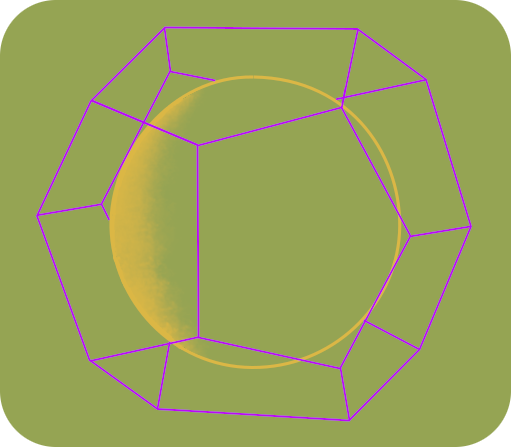 |
The development of a geometric figure is shown from its creation to its dissolution. During the lecture, the participants then reconstructed it in their minds. Readers can also try this exercise here (Images: Author): Link to the dodecahedron image sequence (in German) |
Readers can find the full meditation exercise on my YouTube channel, “Saturno1137” (in German).
Adress: https://youtu.be/9rHj__GWYoo
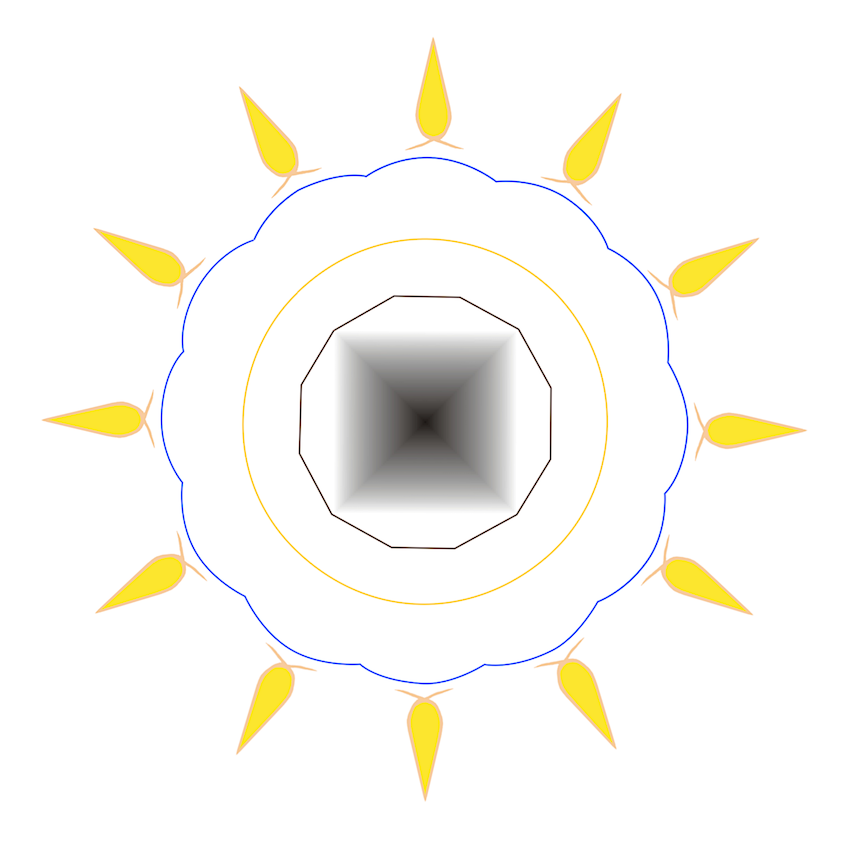 |
Using this image to illustrate the idea that “the path into the depths has an impact far and wide,” readers can also practice another exercise, similar to the one conducted during the lecture through contemplation and recollection (Image: Author). Link to the “Depth Effect” video (in German) |
Readers can find the full meditation exercise on my YouTube channel, “Saturno1137” (in German).
Adress: https://youtu.be/A8cvtPOFWXg
According to spiritual researcher Rudolf Steiner, the various forms of transience in the external world are not equivalent; in short, “death” is not simply “death.” I also presented this distinction to the participants during the lecture. The reader can now understand this distinction through the various linguistic expressions of transience in different spheres of life and nature (based on a compilation by Rudolf Steiner):
|
· The stone is crumbling · The plant withers away · The animal perishes · The human dies · Christ returns to the Father |
(See the book "Das Geheimnis der Zeit" (The Secret of Time), page 309, from a lecture by Rudolf Steiner.)
The book reference is to Andreas Neider’s book, "Der Mensch und das Geheimnis der Zeit", (Man and the Mystery of Time), published by Verlag Freies Geistesleben, ISBN: 978-3772541889.
What is interesting in this compilation is that Steiner once again assigns a distinct role to the death of Christ. For example, in the Gospel of John in the New Testament, Christ does not speak to his disciples, saying, “I will die and rise again,” as a foretelling of his death, but rather he says to them, “I am going to the Father.”
There are a wide variety of assessments and views regarding the concepts of reincarnation and resurrection. In the lecture mentioned above, I examined various texts with the participants, which are presented here:
Texts on Reincarnation
1) From Goethe's poem "Gesang der Geister über den Wassern" (Song of the Spirits Above the Waters):
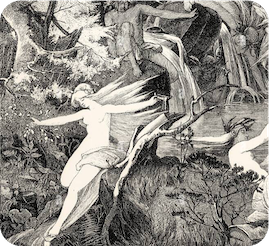 |
Des Menschen Seele (Man´s soul) Gleicht dem Wasser (Resembles the water) Vom Himmel kommt es (It comes from heaven) Zum Himmel steigt es (It rises to heaven) Und wieder nieder (And then must descend) Zur Erde muss es (again to earth) Ewig wechselnd. (Ever changing.) |
Image: Arthur Rackham (1867–1939), illustration for "Gesang der Geister über den Wassern" (Song of the Spirits Above the Waters), ca. 1909, public domain.
2) Diocese of Trier, Episcopal Vicariate General:
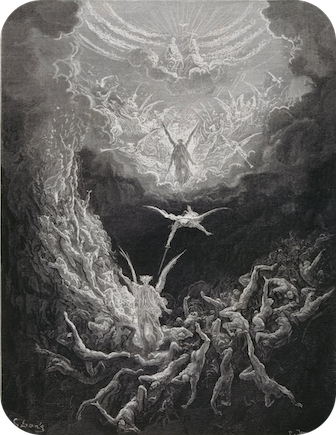 |
Reincarnation - a non-Christian Concept "According to Christian belief, the human person is unique and can only be conceived of as a unity of body and soul. Only in this unique unity of the concrete body and soul is a human being fully human. This is also the basis for the conviction that every human being will be raised to eternal life with body and soul. This, too, rules out the idea that a human essence would be reborn again and again into a new body..." |
Image: Resurrection, Last Judgment, Gustave Doré (1832–1883), La Grande Bible de Tours, 1866, public domain.
3) Hans Wolfgang Schumann, "Der historische Buddha" (“The Historical Buddha”):
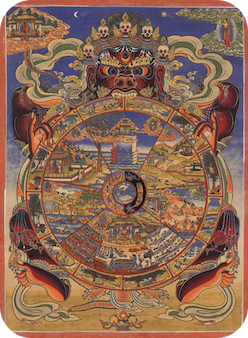 |
On the “Wheel of Rebirth” "All beings are subject to rebirth, whereby suffering does not end with death but continues into the next form of existence. Rebirth is governed by the natural law of pure conditions that are carried over from one existence to the next (karma). The driving forces that keep the cycle of rebirth in motion are the craving for (earthly) existence, which everyone can extinguish within themselves through self-control. Liberation or salvation lies in the termination of the cycle of rebirth through the extinction of the craving for (earthly) existence (the desired state of “no longer returning,” of entering “Nirvana”)." |
Image: The Bhavacakra (Sanskrit; Devanagari: भवचक्र; Pali: bhavacakka), or "Wheel of Coming into Being", is a symbolic representation of the continuous process of existence in the form of a circle, used primarily in Tibetan Buddhism (public domain).
4) Rudolf Steiner 1913, "Von den wiederholten Erdenleben und vom Karma" (On Reincarnation and Karma):
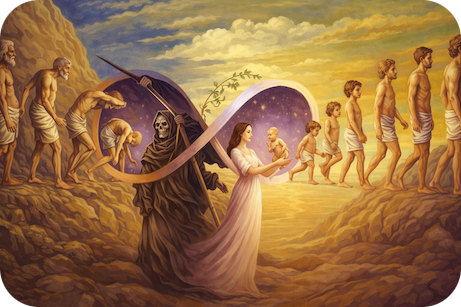 |
“What is referred to by the Eastern term ‘karma’: it grows, in the manner described, together with the ‘other self,’ with the spiritual self. A person's life course appears to be inspired by their own enduring presence, which continues from life to life; and this inspiration takes place in such a way that the fate of a subsequent earthly existence arises as a consequence of the preceding earthly lives.” |
Image: "Wiedergeburt" (Rebirth), AI-generated based on a reference image.
Texts on the Resurrection
1) Gospel of John 5:28–29:
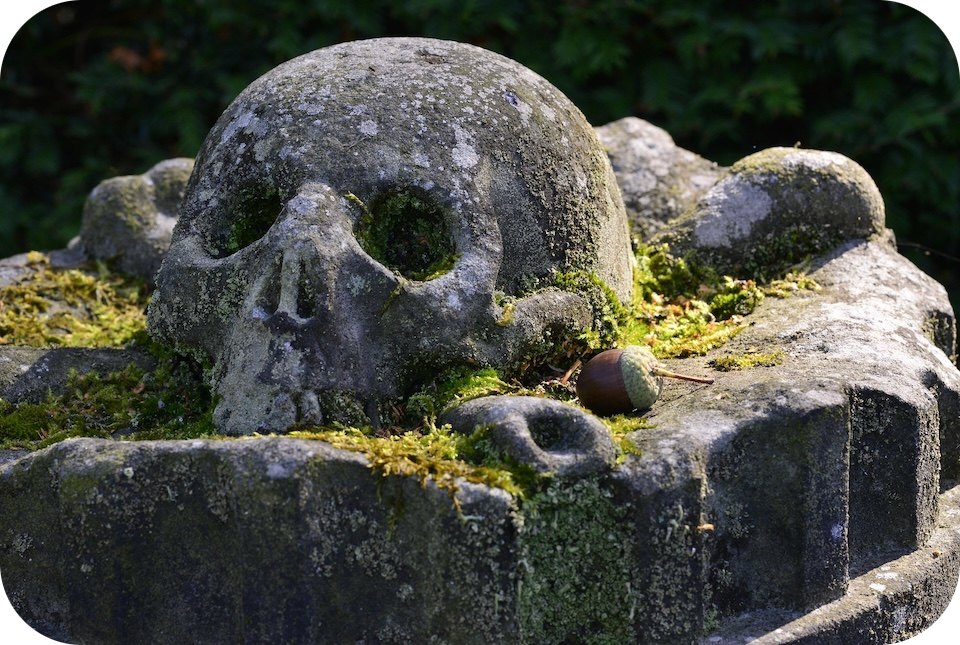 |
“The time is coming when all who are in their graves will hear his call (the call of the Son, the Christ). Those who have done good will come forth and find true life through the resurrection; ...” |
Image: Detail of a headstone in a cemetery, Pixabay.
This raises an interesting question, for example: Who in the graves is supposed to hear the call of Christ if the graves (in the earth) contain only the dust of past bodies, and human beings themselves, as spiritual and soulful beings, pass into the afterlife - or if there is no life after death at all, and human beings are to be raised “from nothing” at the end of time?
2) Rudolf Steiner, "Das esoterische Christentum" (The Esoteric Christianity), page. 286:
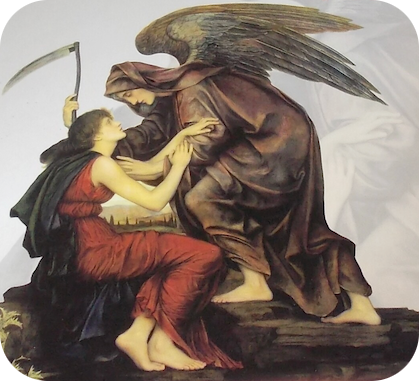 |
"When we explore our Earth, we find that birth and death are its greatest mysteries. The fact that beings can die is, after all, the fundamental problem for humanity’s quest for knowledge. Death and dying exist only on Earth; in the higher worlds there is no death, but only transformation and metamorphosis... and were it not for an intervention by the gods, all of humanity would have become increasingly entangled in a tendency leading to death.” |
Image: Evelyn De Morgan (1855-1919), "The Angel of Death", 1880-1881, public domain.
3) Rudolf Steiner, "Das Sonnen Mysterium und das Mysterium von Tod und Auferstehung" (The Mystery of the Sun and the Mystery of Death and Resurrection), pages 123 - 136:
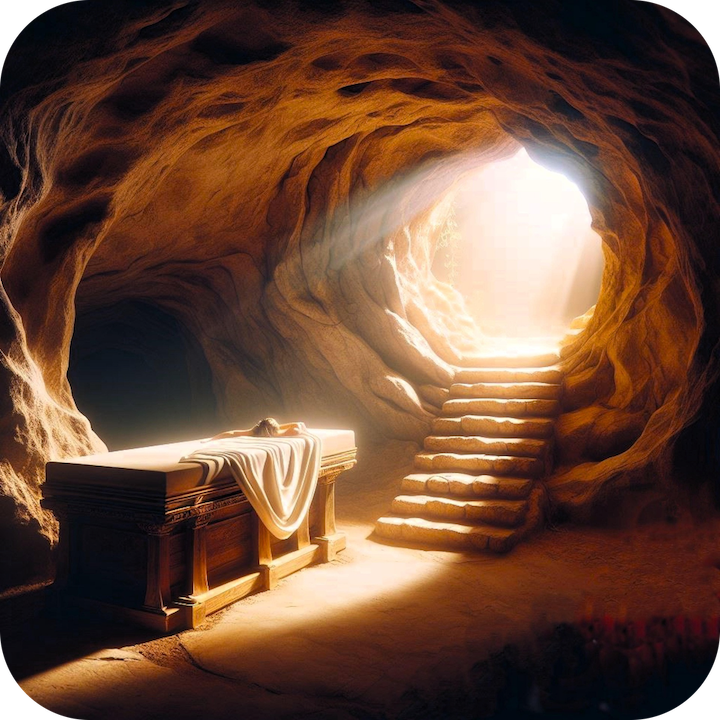 |
“The risen Christ taught the apostles what he had experienced and overcome during his passage through death; he taught them the deeper meaning of death, the ‘mystery of death,’ and what is connected with its overcoming in the form of resurrection and renewal.” |
Image: "Auferstehung" (Resurrection), Pixabay.
The discussions during this part of the lecture raised some interesting questions:
- What has become of humanity through this teaching of the “mystery of death,” or what does it mean for humanity and the world? What is the nature of death, and what of its overcoming - the “resurrection”?
- Why did the divine Spirit (Christ) pass through matter, through death, if changeable matter or death are merely an eternal coming and going, an eternal becoming and passing away of phenomena, to which one should not attach too much significance, as is often expressed in ancient Eastern philosophies?
4) Gerhard Lohfink, "Die Auferstehung Jesu und die historische Kritik" (The Resurrection of Jesus and Historical Criticism), Eberhard Karls University of Tübingen:
"It must be emphatically stated from the outset: When Jesus was raised from the dead, it was not simply a matter of a deceased person returning to life in this world, as was the case with the raising of the young man from Nain (Luke 7:11–17). According to the testimony of Paul’s letters and the Gospels, the resurrection of Jesus is not merely the reanimation of his body, but an eschatological event. This means: With the resurrection of Jesus, the events of the end have already begun; in the risen Jesus, the “new creation” has already begun; the general resurrection of the dead has already begun with him. The Risen One and the process of his resurrection therefore no longer belong to our world.”
What is interesting here is that Christ’s resurrection is described as an “eschatological event” - that is, as the beginning of a “new creation,” the dawn of a “new world” that no longer belongs to our world. But to which world does it belong, then, and what role does humanity itself play in this process?
5) Heinz Grill, response to a question about the understanding of time, November 2025:
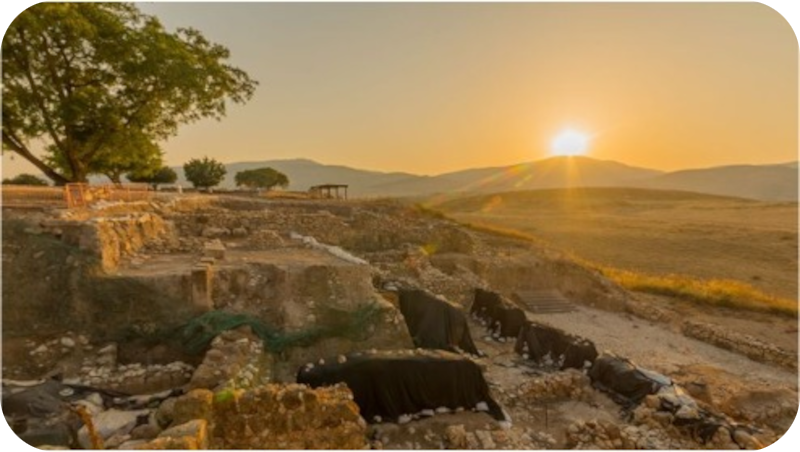 |
“It is certainly true that everything the eye sees (everything that is perceived by the senses) is a reflection of the dead, that is, of what has already passed. The experience of time in the physical world is generally characterized by external events that occur one after another, whereas the experience of time in the spiritual world is characterized by the question of development. In this sense, time is also development.” |
Image: Remains of a ruin, Pixabay.
6) Heinz Grill, "Die Signaturen der Planeten und die seelisch-geistige Entwicklung in der Pädagogik" (The Signatures of the Planets and Psychospiritual Development in Education), pages 51/52:
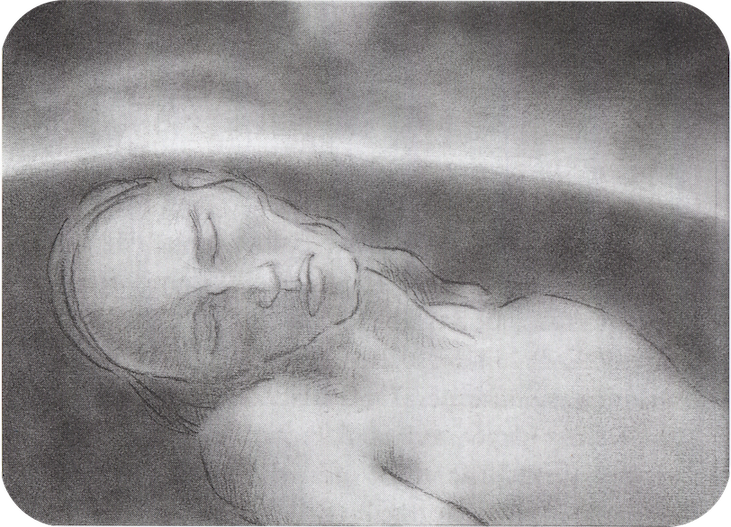 |
"The Spirit of Christ or, more generally, the Spirit of Love, lives within the earth, and this Spirit is sun-like. It is also warm. It breathes out silently and freely from all forms of earthly existence, from solid objects as well as from liquids and gases in a quiet manner… The human ego lives within this exhalation of the Christ Spirit, and it forms itself anew and sovereignly at every moment in the innermost being or in the spiritual existence of the human being." |
Image: “Christ as the Spirit of the Earth,” by Ruurd Relick.
The lecture thus raised further questions:
- Is it possible that human beings evolve from creatures into conscious, free creators? Is there a progression from a purely necessary, law-governed development to a free, creative development?
- How do reincarnation and resurrection relate to the idea of development or “evolution”? What is development, and what is its purpose? Why is there a “resurrection” at all if human beings simply reincarnate over and over again?
Part 2, the lecture:
To illustrate my hypothesis regarding the relationship between reincarnation and resurrection, I draw upon Rudolf Steiner’s views on the origin of the world and cosmology, as expressed in numerous lectures. Specifically, these are the lectures reprinted in the following books:
Rudolf Steiner, "Die Evolution vom Gesichtspunkte des Wahrhaftigen" (Evolution from the Perspective of Truthfulness), TB 761, ISBN 978-3-7274-7610-5.
Rudolf Steiner, "Die Polarität von Dauer und Entwicklung im Menschenleben" (The Polarity of Duration and Development in Human Life), GA 184, ISBN 3-7274-1840-0.
This hypothesis was also informed by an examination of Andreas Neider’s book, titled:
"Der Mensch und das Geheimnis der Zeit" (Man and the Mystery of Time), ISBN 978-3-7725-1908-6.
Thus, the consideration of time and temporal matters, and particularly the polarity between permanence and development, played a major role in the elaboration of this topic, since the concept of “permanence” or “eternity” - that is, of what remains eternally unchanged - seems to contradict the idea of development for the world as a whole, including the spiritual world.
It is very important to understand that the origin of the world is described quite differently in Rudolf Steiner’s spiritual science than in mainstream science today.
In mainstream science, it can be said, to put it simply, that the universe evolves in a linear fashion. From the Big Bang, through processes of condensation and compression, material structures form within an expanding spacetime until they reach their present state, which we then refer to as planets, stars, galaxies, and so on.
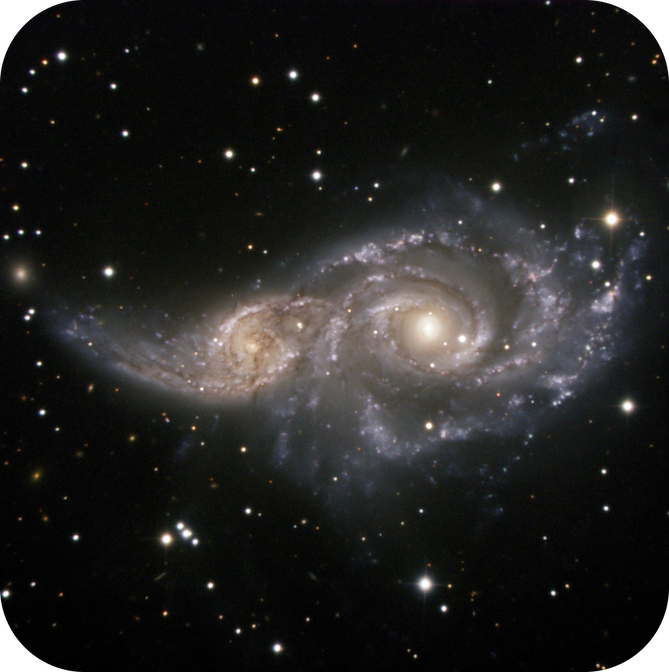 |
The universe, with its stars and galaxies, came into being as a result of a singular or point-like “Big Bang” that occurred “billions of years ago.” The Big Bang itself, with its “inconceivable energy density and unimaginably high temperatures,” defies any visual description as a point-like state. Image: Wikilmages, Pixabay. |
According to Rudolf Steiner, the creation and development of the world occur in stages. There is a first form of the world that appears and takes shape, in which everything still exists in a highly refined state, but which then disappears again, that is, dissolves completely. Then the world reappears in a second stage, initially repeating the old, but then something new is added - something like a further shaping of the world. This stage, too, dissolves completely, that is, it disappears. It is not merely that the world stage becomes more nebulous or something like “thinner,” but it truly vanishes completely. Then the world reappears in a third stage, and so on. So, according to Steiner, the development of the world is not linear, but rather occurs in stages. What we today call the Earth and its entire cosmic environment is the fourth stage of the world according to this view, and the world’s future development will also unfold in stages through a sequence of formation, dissolution, and reformation.
The sequence of the four-stage worlds and their characters is best represented by pictorial symbols, whose appearance and order have an almost meditative quality:
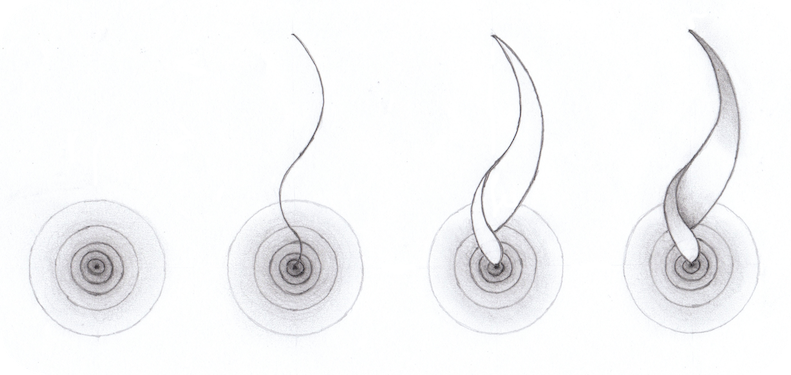 |
From left to right: “From a wide radius, a center emerges in a radial movement. It is a kind of primal beginning, a time of origin. From this center, a line springs forth in a rhythmic, undulating motion. Through receding lines or movements, two-dimensional forms unfold, eventually curving into the third dimension of a three-dimensional space.” (Drawings: Author.)
For Steiner, the world appears as a kind of organism within a cosmic consciousness that unfolds in stages of emerging and passing away.
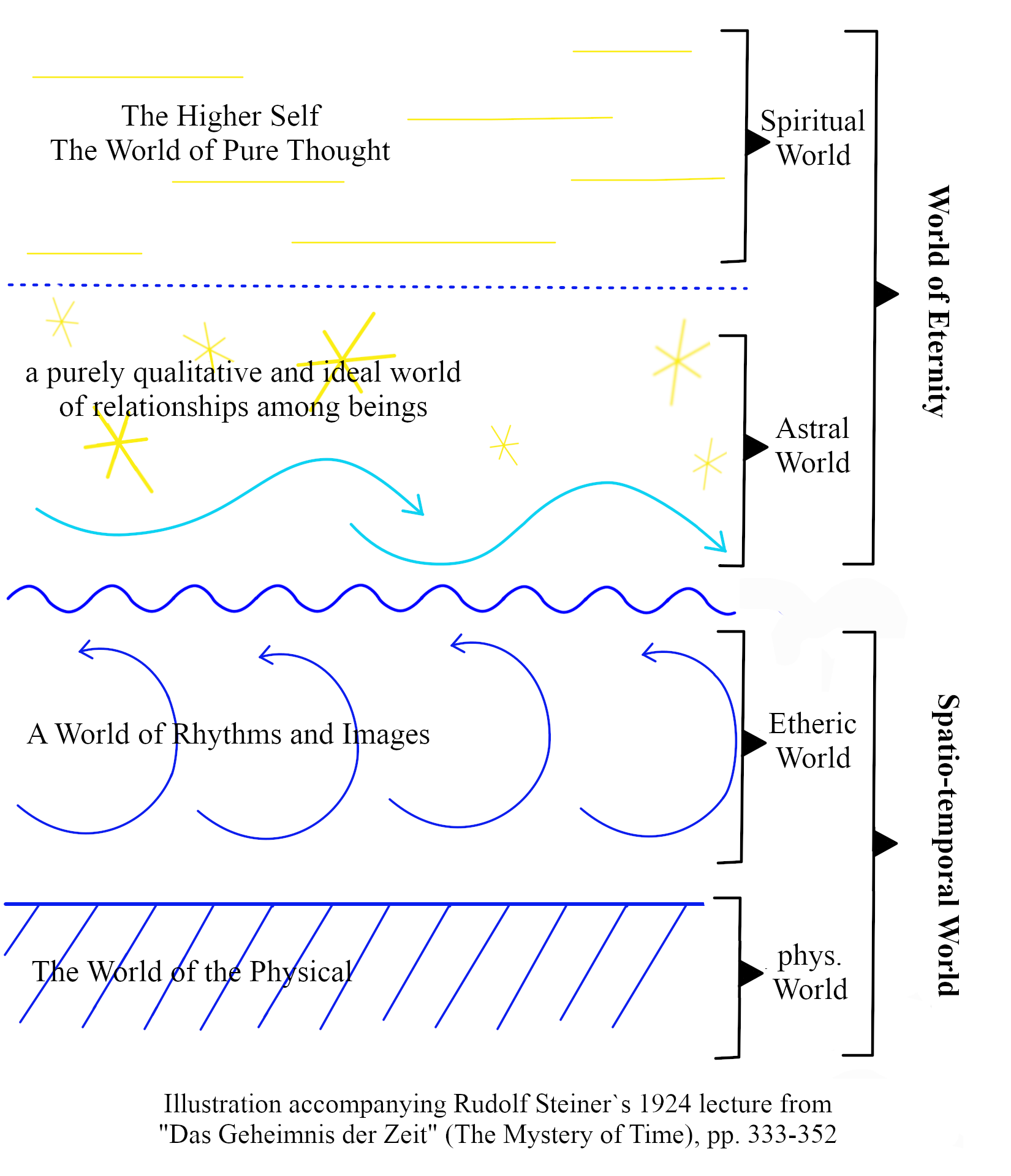
First, I would like to explain the relationship between the permanent and the transitory, as I have understood it from the writings mentioned above.
 |
|
Graphic: Author.
This pure form of the separation of duration and temporality corresponds to a certain stage in the development of the world, a stage that has already been surpassed, as I will explain later on.
So we return to the question of how development can take place for the entire world - including the spiritual world - when everything in the spiritual world is eternal, that is, unchanging, and changes (development) are possible only in the lower world. How, then, can there be “becoming and passing away,” a process of development for the entire world?
This question is central to the relationship between reincarnation and resurrection as presented here, as I will show below.
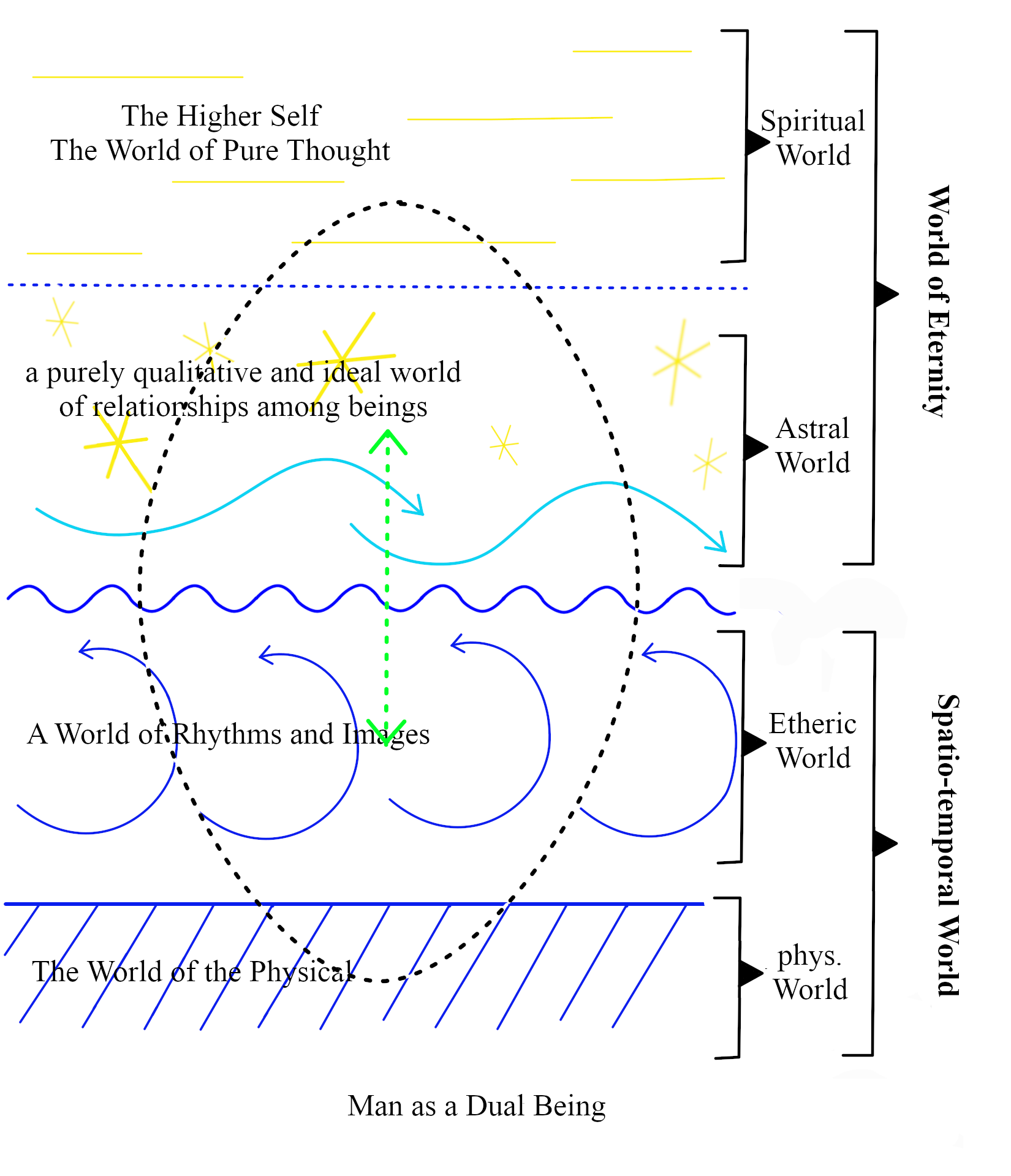
Another key question is: What is humanity’s place in this temporally structured world?
 |
|
Graphic: Author.
Through his outward appearance in his earthly, physical form and in the forms of consciousness bound to this physicality, the human being reveals himself as a transient being. His earthly lifespan is bounded by birth and death; his physical and mental forms are subject to constant change. Nevertheless, even in this outer life, human beings are connected to the spiritual core of their being, even if they are not consciously aware of this connection in their everyday lives.
After death, a person initially continues to live in the world of eternity as a disembodied spiritual and soul-based being, and later as a purely spiritual entity. However, even here, the person remains connected to the physical realm, since it is in these realms that the physical body is already being prepared for the next incarnation.
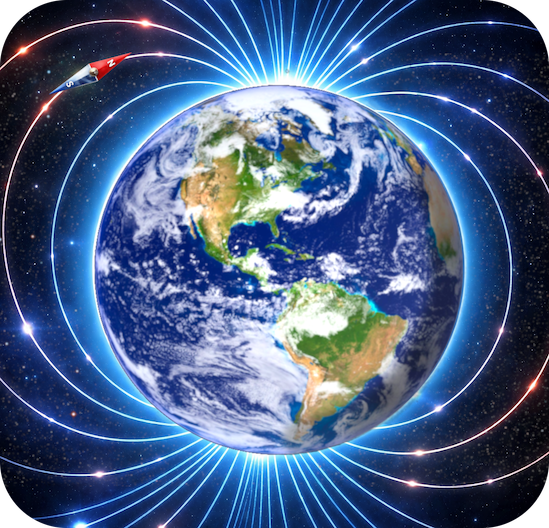 |
The position of an imaginary compass needle in Earth’s cosmic magnetic field as a symbol of human orientation in cosmic time. (Image: AI.) Rudolf Steiner offers an interesting description of how human beings fit into a greater whole¹): Just as the magnetic needle of a compass aligns itself with the cosmic-spatial dimensions of the Earth’s magnetic field, so too does the human being align itself with the cosmic-temporal dimensions. The distant past and the distant future are both inherent in the human being. Just as the compass needle points to the south and to the north, so too does the human being, even in his physical constitution, point both toward the past and toward the future. |
1) Rudolf Steiner, "Die Polarität von Dauer und Entwicklung im Menschenleben" (The Polarity of Duration and Development in Human Life), pp. 97/98 u. p.105, GA 184, ISBN 3-7274-1840-0.
Thus, for human beings, temporality - or time itself - is never truly abolished, and they belong to both worlds: the world of permanence and the world of space and time, even though the spiritual is the defining factor in the afterlife, whereas in earthly life, physicality or transience dominates, at least on the surface. This dual nature - the alternation between a purely spiritual life and an earthly existence - already hints, in embryonic form, at something that could lead to the overcoming of the polarity between permanence and transience.
To further examine the relationship between reincarnation and resurrection, I will now present a schematic overview of the world’s development in successive stages with respect to time:
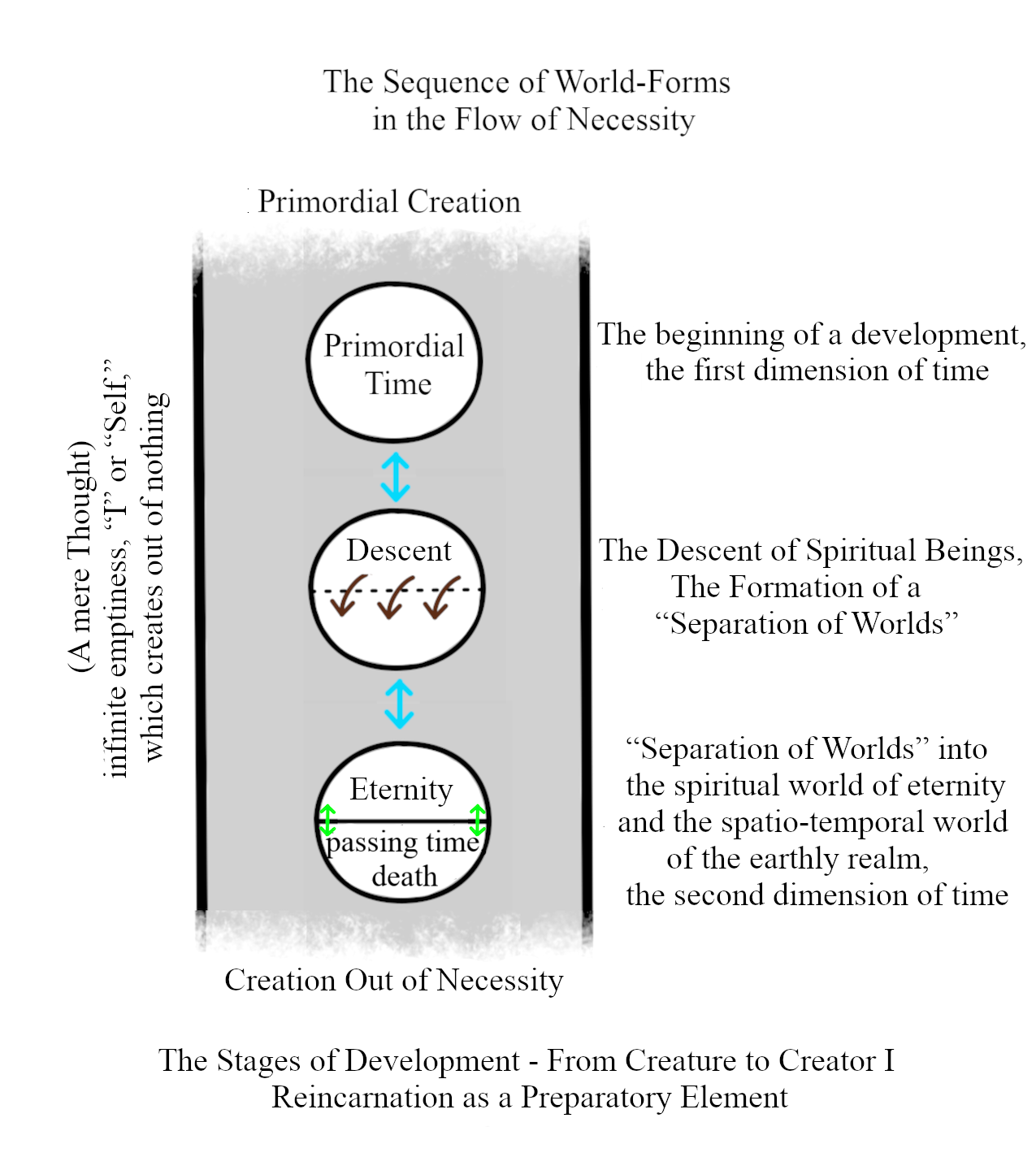 |
The first three stages of global development in terms of time (Graphic: Author):
|
It should be noted that each stage, after its formation and development, disappears completely and necessarily reemerges, repeating the old and inevitably giving rise to what follows. What is depicted in the illustration as a spatial arrangement and could be interpreted as a temporal sequence is, in reality, an interpenetration of world states. Thus, the “old” or “earlier” world stages still exist today within the current world stage. However, they are not readily comprehensible to human beings.
The third level of the world corresponds to the more detailed picture presented above of a relationship between permanence and transience that essentially still exists.
This article is still in progress